Bonding Services

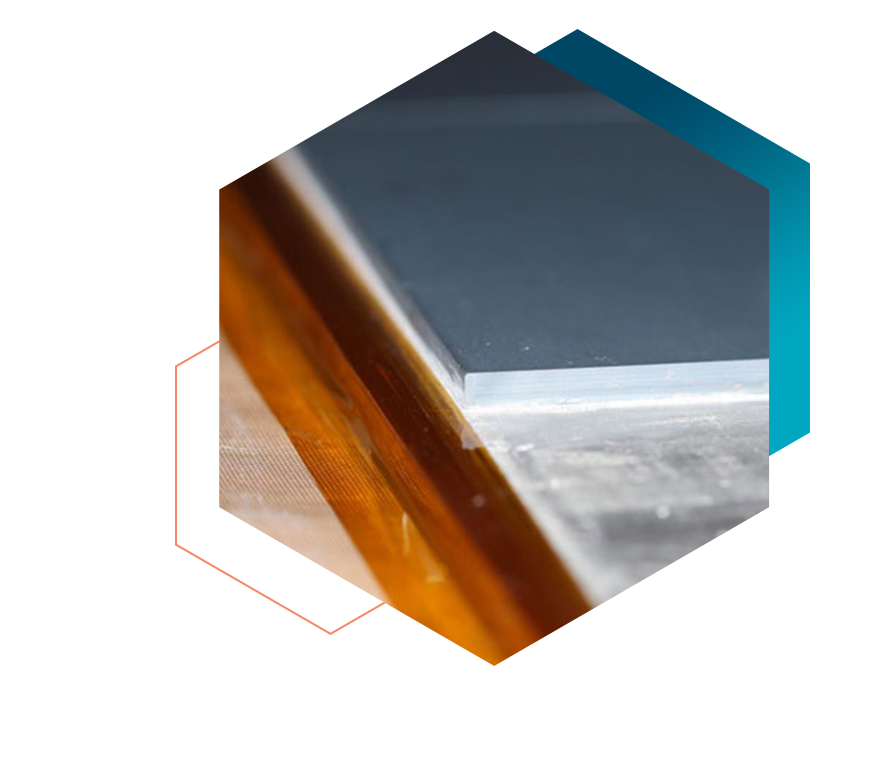

A precisely executed bond improves thermal transfer and mechanical integrity, enabling higher power loads and faster deposition rates without compromising film quality. VTFM offers multiple bonding methods and a wide selection of backing plate materials and configurations, all tailored to meet the requirements of your specific coating system.
Backing Plate Options
Backing plates are essential for thermal management and structural support during sputtering. Vital offers backing plates for planar and rotary targets, available up to 4000 mm in length.
Common backing plate materials include:
- Aluminum (Al)
- Copper (Cu)
- Molybdenum (Mo)
- Titanium (Ti)
All backing plates are precision-machined to ensure flatness, surface uniformity, and compatibility with your cathode system.
Indium Bonding
Indium bonding is the most widely used method for sputtering targets due to its excellent thermal conductivity and ductility. This process uses a thin indium solder layer between the target and backing plate to create a highly efficient thermal interface.
- Ideal for materials requiring moderate power levels
- Enables uniform heat transfer and stable deposition
- Melting point: 156°C, requiring effective cooling to maintain performance
Indium bonding is suitable for most metal and oxide targets, offering a balance between performance, cost, and reusability.
Diffusion Bonding
Diffusion bonding is a solid-state welding technique used to join similar or dissimilar metals through atomic diffusion under controlled heat and pressure. This creates a metallurgical bond without the use of filler materials, resulting in an extremely strong and thermally efficient interface.
- Suitable for high-power and semiconductor-grade applications
- Withstands extreme sputtering conditions
- Backing plate cannot be reused after bonding
Although more expensive, diffusion bonding delivers superior thermal conductivity and reliability for advanced coating systems.
Silver Epoxy Bonding
Silver epoxy bonding is typically used for brittle, temperature-sensitive, or non-metallic targets that cannot withstand the heat or pressure of other bonding methods. A thin layer of thermally and electrically conductive silver epoxy is applied between the target and backing plate.
- Provides gentle bonding for fragile materials
- Electrically and thermally conductive
- Higher thermal resistance limits power density and deposition rate
This method offers flexibility for specialized applications where material integrity is the top priority.
Advantages of Vital Bonding Services
- Full in-house capability for indium, diffusion, and epoxy bonding
- Precision machining and surface preparation for optimal adhesion
- Custom backing plate design and fabrication
- Bond quality verification and process traceability
- Global support for sputtering target re-bonding and refurbishment
Applications
- Semiconductor manufacturing and microelectronics
- Display and photovoltaic coating systems
- Optical and decorative coatings
- R&D and pilot-scale coating systems